Seen In The Field is a new short series from Matlyn Nature Photography about the moments that make a walk in the woods worth the early alarm. Each episode collects a handful of frames from recent outings and pairs them with a few notes on what you are looking at and how to recognise it yourself.
The first episode is a mixed bag in the best way: one genetic rarity, one secretive hunter most people never see, one bird caught in a split second, and one organism that isn’t an animal at all. Watch the video, then read on for the field notes behind each photograph.
In this episode
01. Eastern Gray Squirrel, white phase
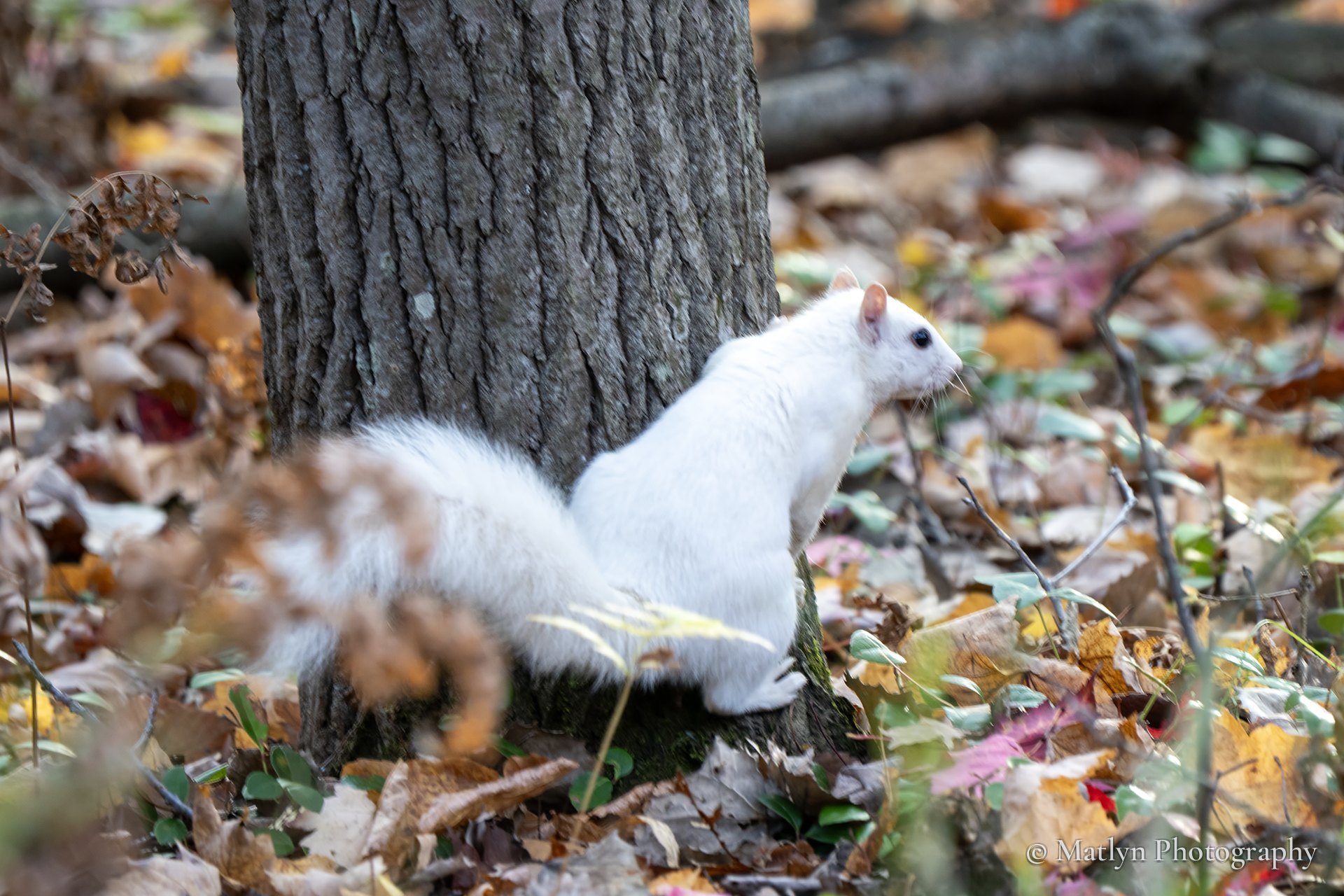
White squirrels are not a separate species. Almost all of them are ordinary eastern gray squirrels carrying a recessive gene for leucism, a partial loss of pigment in the fur. Small pockets of them turn up where that gene is common in the local population, and a few towns have made their white squirrels into local mascots.
The quickest way to tell leucism from albinism is to look at the eyes. A true albino lacks melanin entirely and has pink or red eyes. This squirrel’s eyes are dark, so it is leucistic. Albino squirrels are far rarer, and pale animals of either kind face a real cost: against brown leaves and bark, a white coat is easy for hawks and foxes to pick out.
That same visibility is what makes this frame work. Set against the autumn leaves and the dark trunk, the squirrel reads instantly, even at a glance.
Field marks
- Coat: white or near-white, sometimes with faint grey patches
- Eyes: dark, as in a normal gray squirrel. Red or pink eyes would mean albinism
- Build: same size, shape and bushy tail as its grey neighbours
02. American Mink
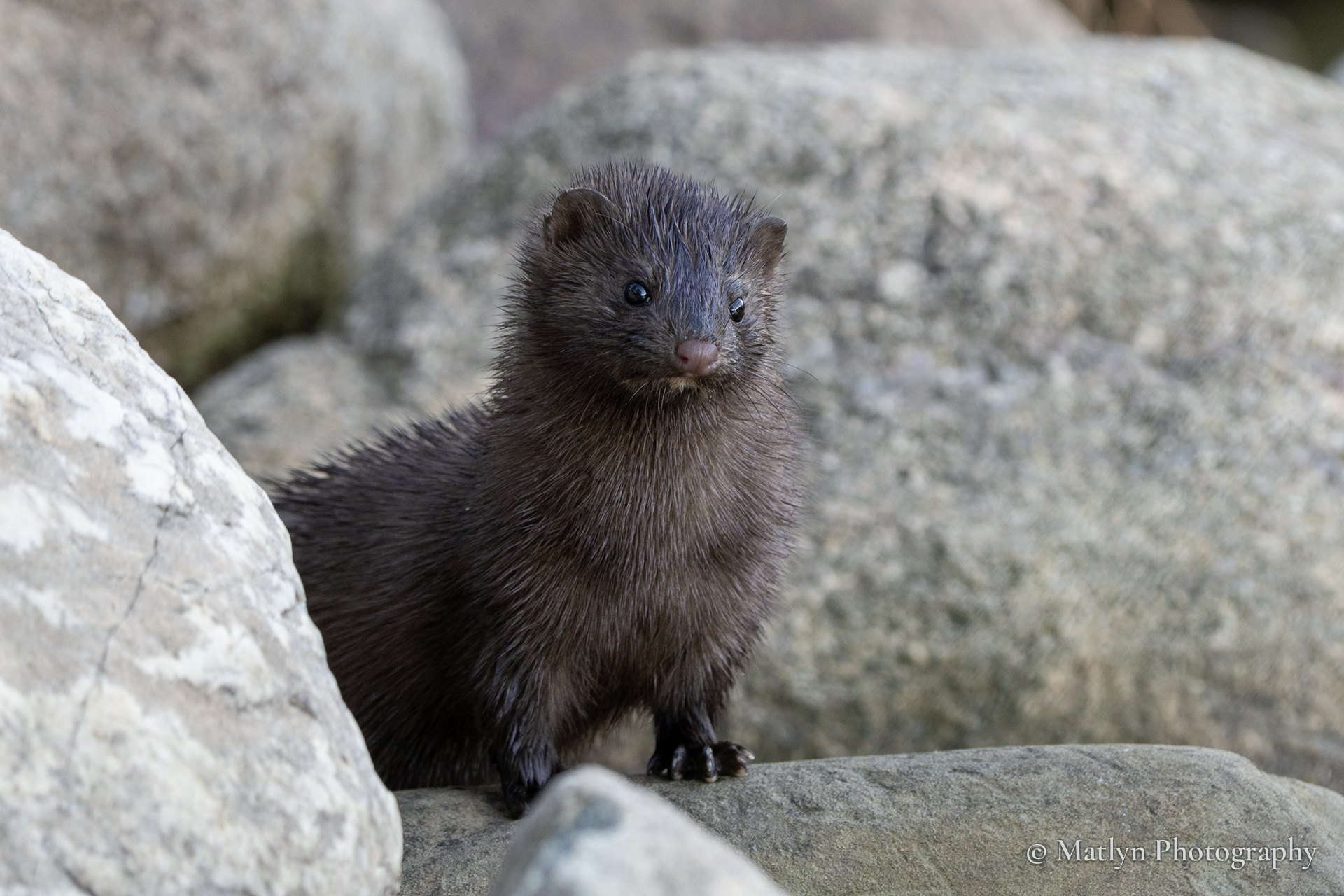
The mink is a member of the weasel family built for life at the water’s edge. Its toes are partly webbed, and oily outer guard hairs keep its dense underfur dry while it swims. It hunts both in the water and on land, taking fish, crayfish and frogs as readily as mice, muskrats and birds.
Mink are common in the right habitat but hard to see. They are mostly active at night and around dawn and dusk, and they tend to stay close to rocks, roots and brush where they can vanish in a second. An encounter like this one, with the animal stopping to look back from the boulders, is usually brief.
If you have an older field guide, you may find it listed as Mustela vison or Neovison vison. Recent genetic work moved the American mink into the genus Neogale, alongside a few New World weasels.
Field marks
- Coat: rich dark brown and glossy, often with a small white patch on the chin
- Shape: long, low body, short legs, small rounded ears and a pointed face
- Where: close to water with cover nearby, such as rocky shores, stream banks and marsh edges
03. Bald Eagle, taking a fish
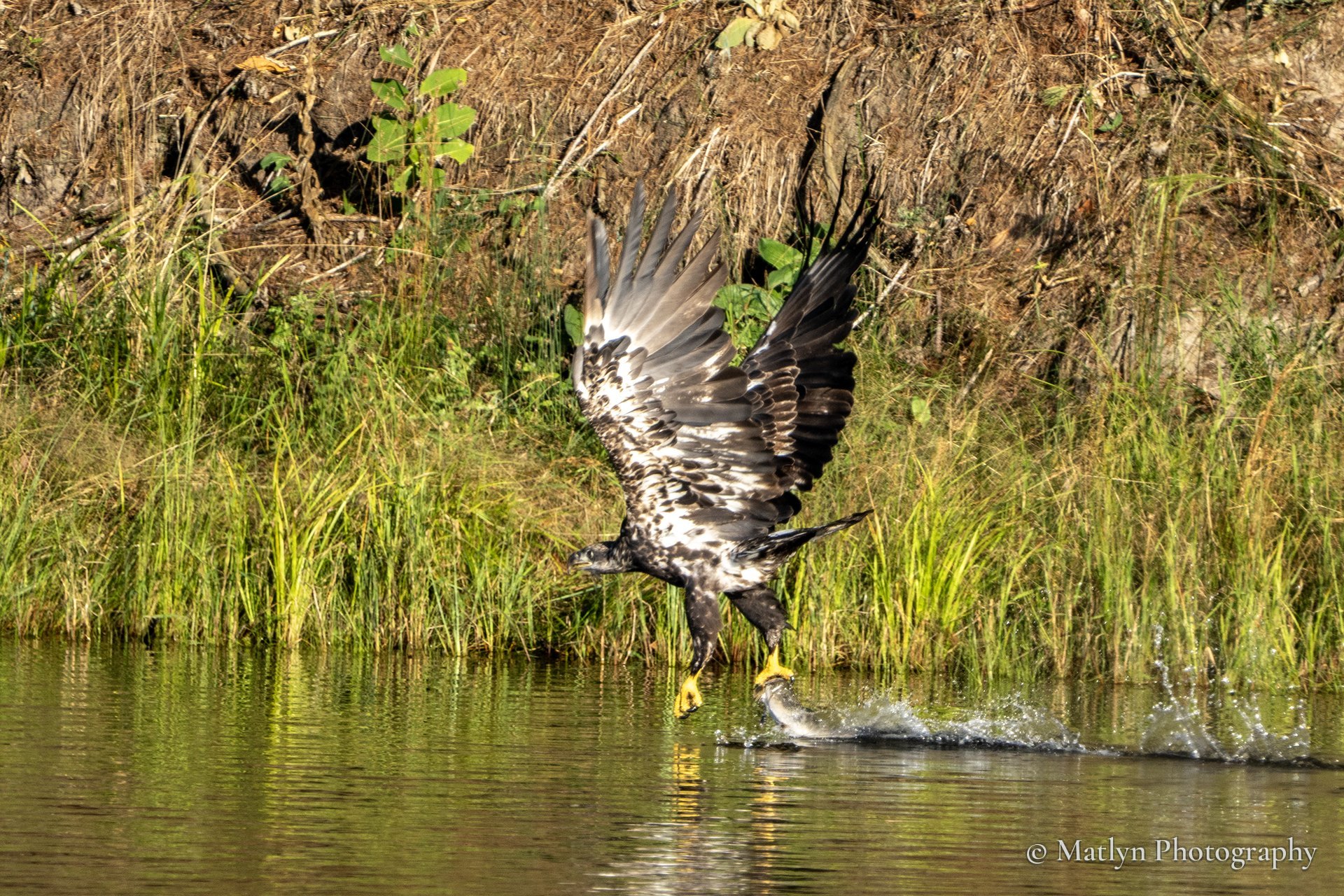
Without the white head, this bird doesn’t look like the national symbol at all, and young bald eagles are often mistaken for golden eagles. A bald eagle spends its first few years in a series of brown plumages splashed with white, and only takes on the clean white head and tail at around four to five years old.
The heavy white mottling across this bird’s body and wings suggests it is past its first year, when young eagles are at their darkest. Plumage varies a lot between individuals at this stage, though, so its exact age is hard to pin down from a photograph.
Bald eagles fish by gliding low over the water and snatching prey from just below the surface with their talons, usually without getting more than their feet wet. This frame catches the instant of contact: the wings raised to lift off, the yellow feet down, and the fish breaking the surface in a burst of spray.
Field marks
- Plumage: dark brown mottled with white, with no white head or tail yet
- Bill: dark in young birds, turning yellow as they mature
- Size: very large, with long broad wings. Young birds can look even bigger than adults
04. Chicken of the Woods
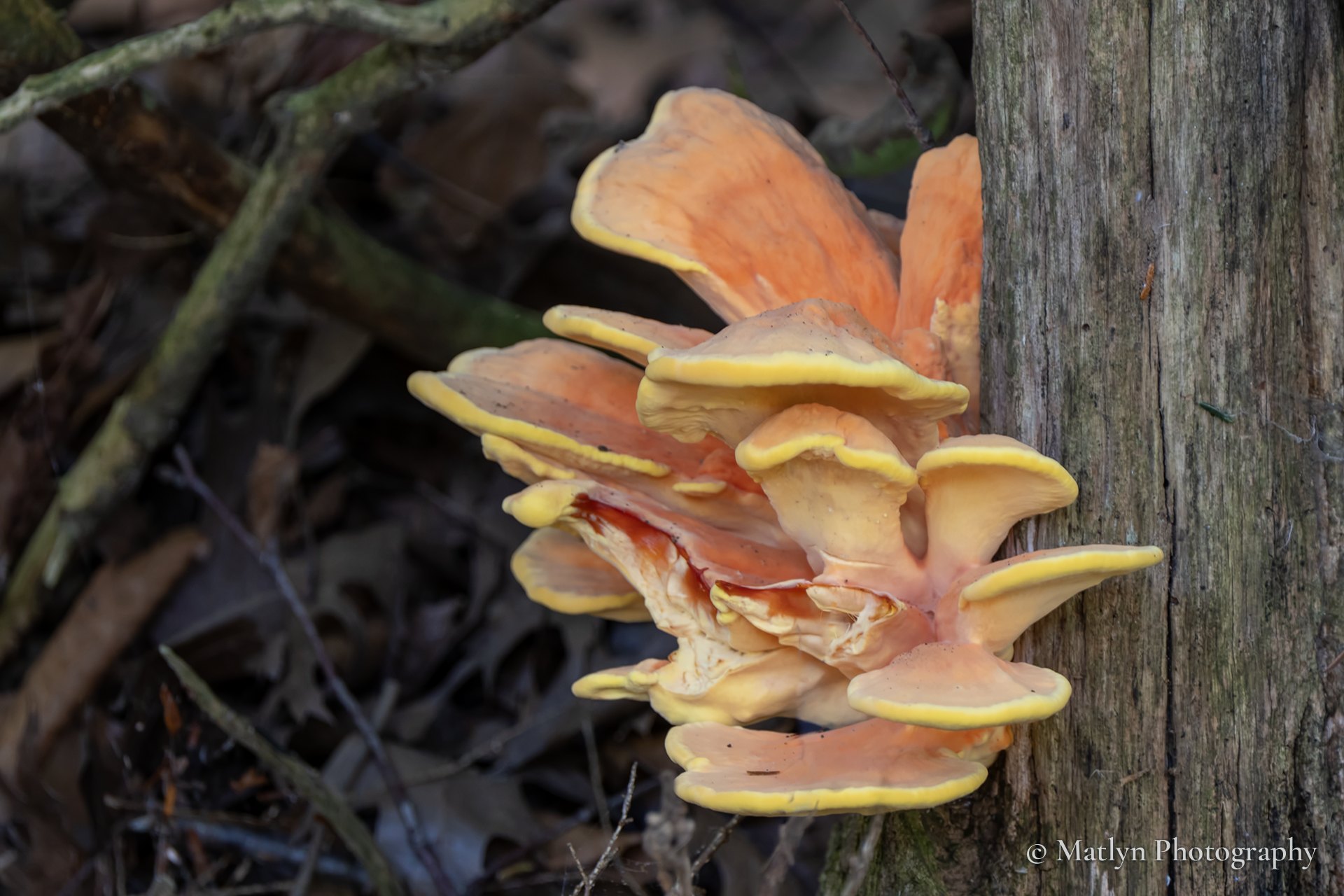
Not every sighting needs to have a heartbeat. Chicken of the woods, also called the sulphur shelf, is one of the easiest fungi in the forest to spot: few other things in the woods are this shade of orange. What you see is only the fruiting body. The rest of the fungus lives inside the tree, slowly breaking down the heartwood.
That decay is a brown rot, which leaves wood crumbly and weak, so a tree carrying a big flush of these shelves may be more fragile than it looks. A close relative, the pale chicken of the woods (Laetiporus cincinnatus), grows from the ground near the base of oaks and has a white underside instead of yellow.
Field marks
- Form: overlapping, fan-shaped shelves, often in large tiered clusters
- Colour: orange caps with sulphur-yellow edges and a yellow pore surface underneath
- Host: living or dead hardwoods, especially oak
A note on foraging
The name comes from its texture when cooked, and it is a well-known edible. It can still upset some people’s stomachs, especially if undercooked, and a few people are allergic. Please don’t eat a wild mushroom on the strength of a photograph: confirm any identification in person with an experienced local forager.
About the series
Seen In The Field is a running notebook of wildlife and wild things from Matlyn Nature Photography. Each episode is a short video and a post like this one: a few photographs, the story of what is in them, and the field marks that help you find them for yourself. Episode 02 is on its way.
Further reading
- What’s up with white squirrels and black squirrels? (The Nature Conservancy)
- American Mink field guide (Missouri Department of Conservation)
- Juvenile bald eagle (U.S. Fish & Wildlife Service)
- Chicken of the Woods (UF/IFAS Extension)